About us
The Japanese society of pediatric acupuncture is committed for the further development of Shonihari with its continuous study and promotion on Shonihari, means of we are aimed to contribute for the health promotion of all children. In order to reach to our above-mentioned goal, the following activities and business are conducted.
(1) Activities and Business related to research on pediatric acupuncture
(2) Publishing of journals for academic society and of other related publications
(3) Collaboration and exchange with related organizations and institutions domestic and abroad
(4) Activities and business incidental to or related to the above-listed (1)(2)(3)
The Japanese society of pediatric acupuncture were established in April 2007 aiming to contribute to child’s health promotion through the treatment of Shonihari, and researching and promoting Shonihari.
Since then, we hold the academic meeting in various places in Japan, interacting with overseas practitioners, and striving to promote Shonihari.
In this opportunity, we applied for a general incorporated association, aiming to carry out activities with a high public interest and to promote Shonihari to the public extensively, and it was approved on August 9, 2010.
We will make further efforts to activities for the health promotion of all children by Shonihari treatment.
Society Overview (As of January 2025)
About Shonihari
Shonihari (Pediatric acupuncture, also known as Shonishin in Japan) was developed as a form of acupuncture specifically for children and actively practiced from the latter part of the Edo Period. It became established in a unique way over time as a specialized acupuncture technique in Japan.
Shonihari’s main distinguishing feature is that instead of inserting needles, needle-like tools are used with rubbing the surface of the skin or gently tapping and repeated contact on the skin.*
Adapted to symptoms of the individual child, the areas (meridian or acupuncture points) where effect expected are treated. This acupuncture technique using very light stimulation is comforting for infants and children so that some children fall asleep during the treatment.
The duration of one treatment is very short as two-to-five minutes, but it relaxes the child and improves symptoms of autonomic nerves, night-time crying, Kan-mushi (tantrums and squealing), constipation, indigestion, and nocturnal enuresis.
In recent years, treatments are also applied for school refusal and developmental disorders.
Mainly, the age range for Shonihari is from infancy to elementary school age (from 0 to about 12).
Recently this technique is practicing not only to children but also to older children (junior high school and high school students), adults with symptoms of autonomic nerves, aging adults with dementia – thus its potential of Shonihari’s effective come to draw attention.
Regarding the mechanism of “Shonihari”, currently the research is underway about the effect of stimulation on the skin enhancing the release of neurochemicals and balancing the autonomic nervous system is underway.
*Generally for children, above-mentioned technique of pediatric acupuncture is mainly applied, but in some cases, normal acupuncture (inserting needles) or moxibustion may also add to be applied adapted to the symptoms and diseases.
History
Board Members

Notice of the 19th Academic Meeting
“Parents, Children, and Shonihari (Pediatric Acupuncture)”
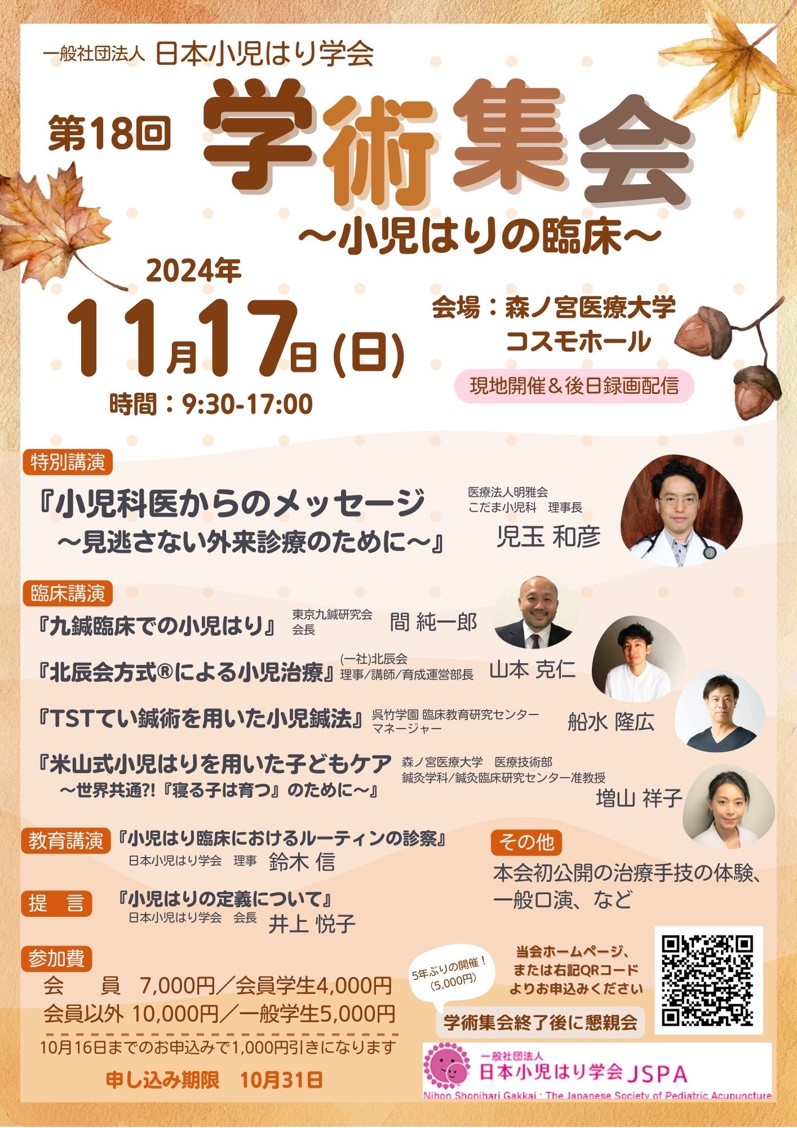
Notice of the 18th Academic Meeting
“Clinical Practice of Shonihari (Pediatric Acupuncture)”
Notice of the 17th Academic Meeting
“Reconsidering Pediatric Acupuncture”

Notice of the 16th Academic Meeting
“Why Does Shonihari (Pediatric Acupuncture) Work?”

Notice of the 15th Academic Meeting
“Shonihari (Pediatric Acupuncture) within Traditional Japanese Medicine”
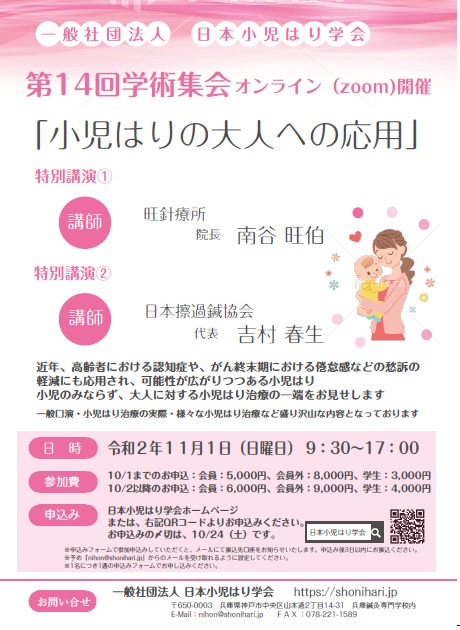
Notice of the 14th Academic Meeting
“The application of Shonihari to the adult.”
| Meeting No. / Date | Place | Theme | Lecturers |
|---|---|---|---|
| No. 13 October 27, 2019 |
Kobe | Shonihari from the Perspective of Both Eastern and Western Medicine | Atsushi Takahashi, Seiji Yamaguchi |
| No. 12 September 30, 2018 |
Tokyo | Effects of Micro-stimulation in Shonihari | Harumi Hotta |
| No. 11 October 1, 2017 |
Osaka | The Potential of Shonihari | So Yamaguchi, Naoya Ono |
| No. 10 September 23–24, 2016 |
Himeji | 10th Anniversary Meeting | Kazumi Tomita |
| No. 9 September 27, 2015 |
Nagoya | The Wonders of the Skin | Tadashi Yano |
| No. 8 September 28, 2014 |
Osaka | Atopic Dermatitis and Shonihari | Mitsuko Sato |
| No. 7 September 23, 2013 |
Kobe | For the Healthy Development of Children | Keigo Morita |
| No. 6 September 23, 2012 |
Kyoto | For the Healthy Development of Children | Yasuko Daigoku, Hiroshi Yamamoto |
| No. 5 September 23, 2011 |
Osaka | For the Healthy Development of Children | Koei Kuwahara, Thomas Wernicke |
| No. 4 October 30, 2010 |
Kobe | Understanding the Mind and Body of Children | Kimiko Ohashi, Yasuhiro Takeshima |
| No. 3 October 4, 2009 |
Tokyo | Live Demonstration: Eastern and Western Shonihari Techniques | Thomas Wernicke, Karin Wernicke |
| No. 2 September 11, 2008 |
Osaka | For the Healthy Development of Children | Sekizo Harada |
| No. 1 November 3, 2007 |
Kobe | A New Era of Shonihari (Pediatric Acupuncture) | Hideo Miyahara |
【Special Training Seminar】
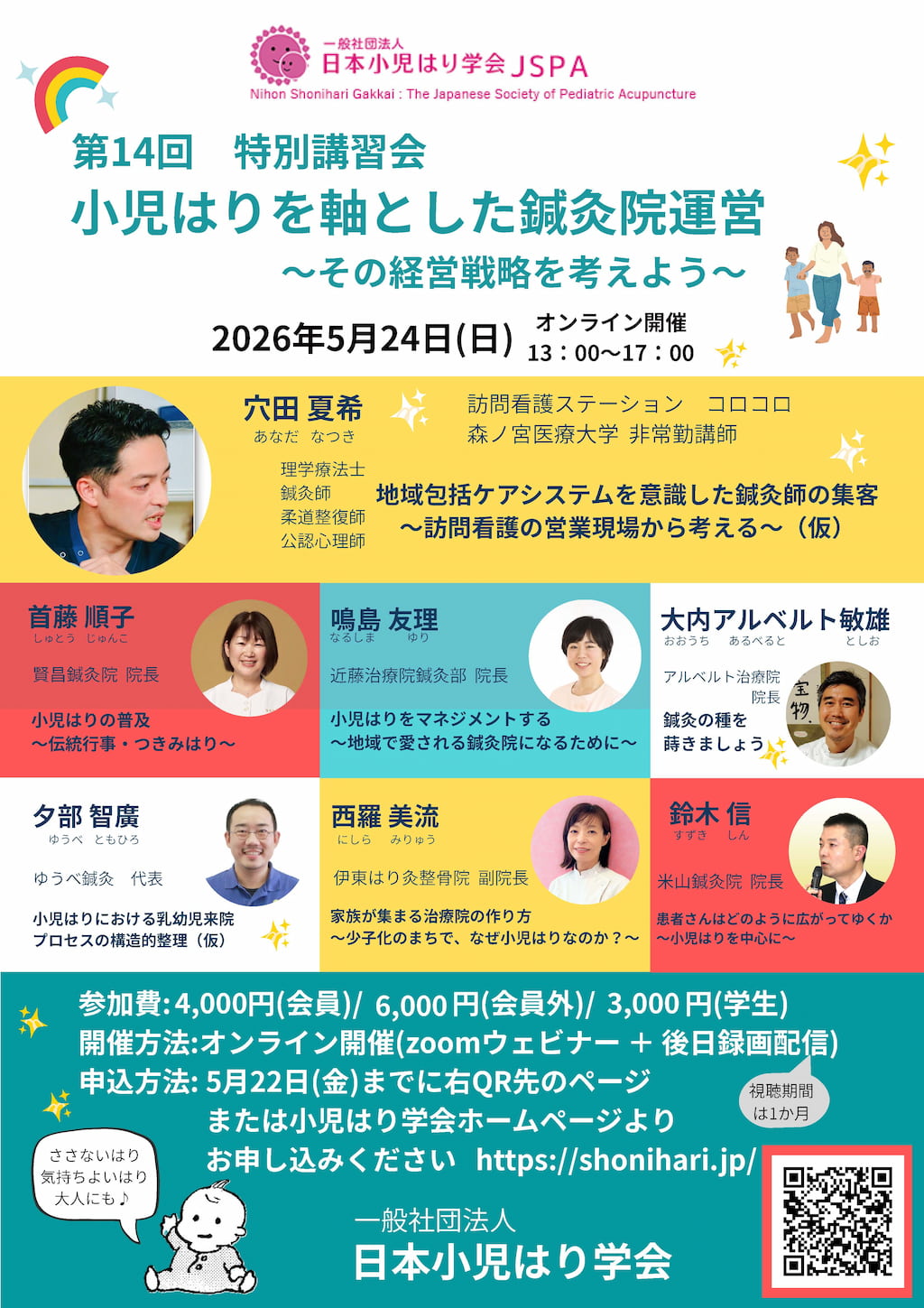
14th Special Training Seminar
“Clinic Management Centered on Pediatric Acupuncture – Exploring Effective Business Strategies”
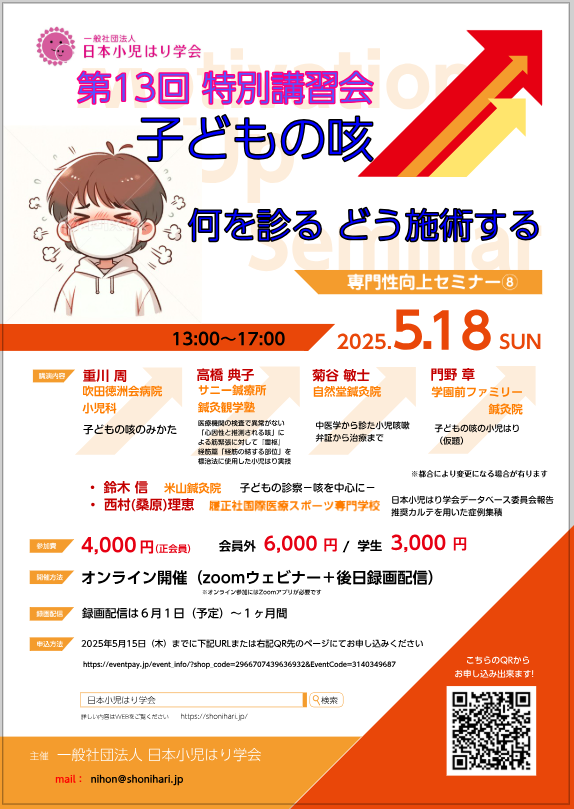
13th Special Training Seminar – Professional Development Seminar (8)
“Children’s Cough – What Should We Examine? How Should We Treat?”
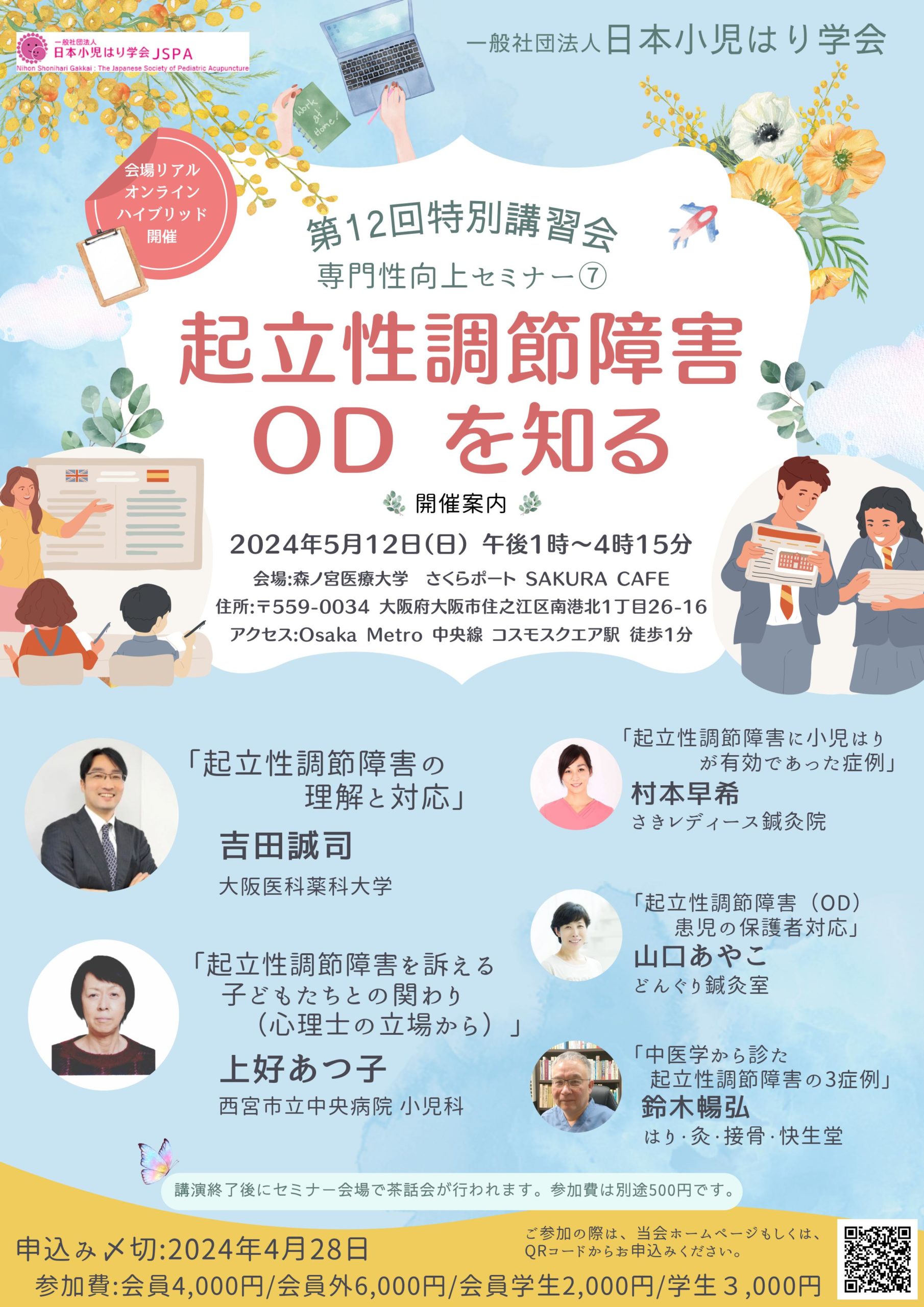
12th Special Training Seminar
“Understanding Orthostatic Dysregulation (OD)”
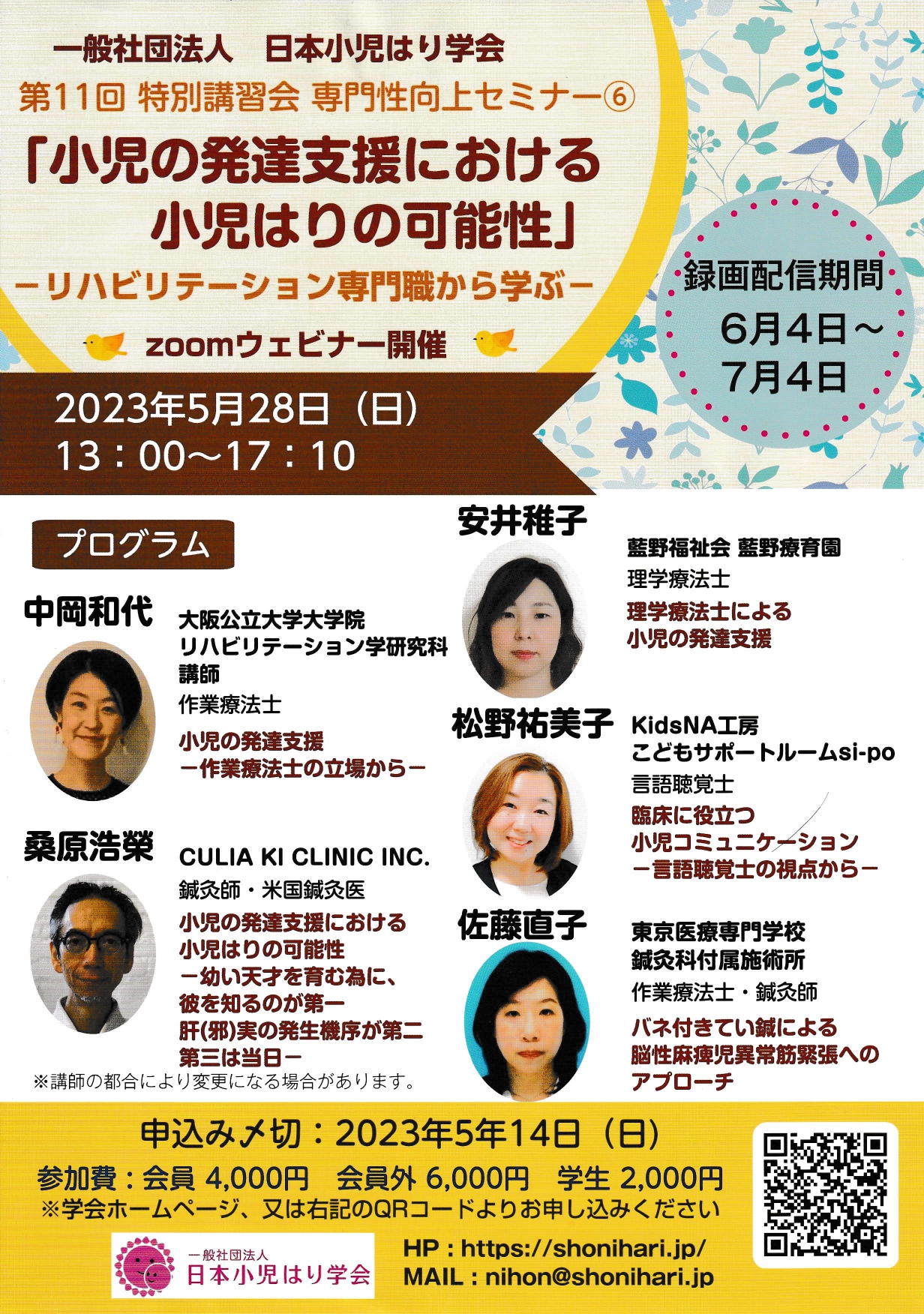
11th Special Training Seminar
“The Potential of Shonihari (Pediatric Acupuncture) in Supporting Child Development – Learning from Rehabilitation Professionals –”
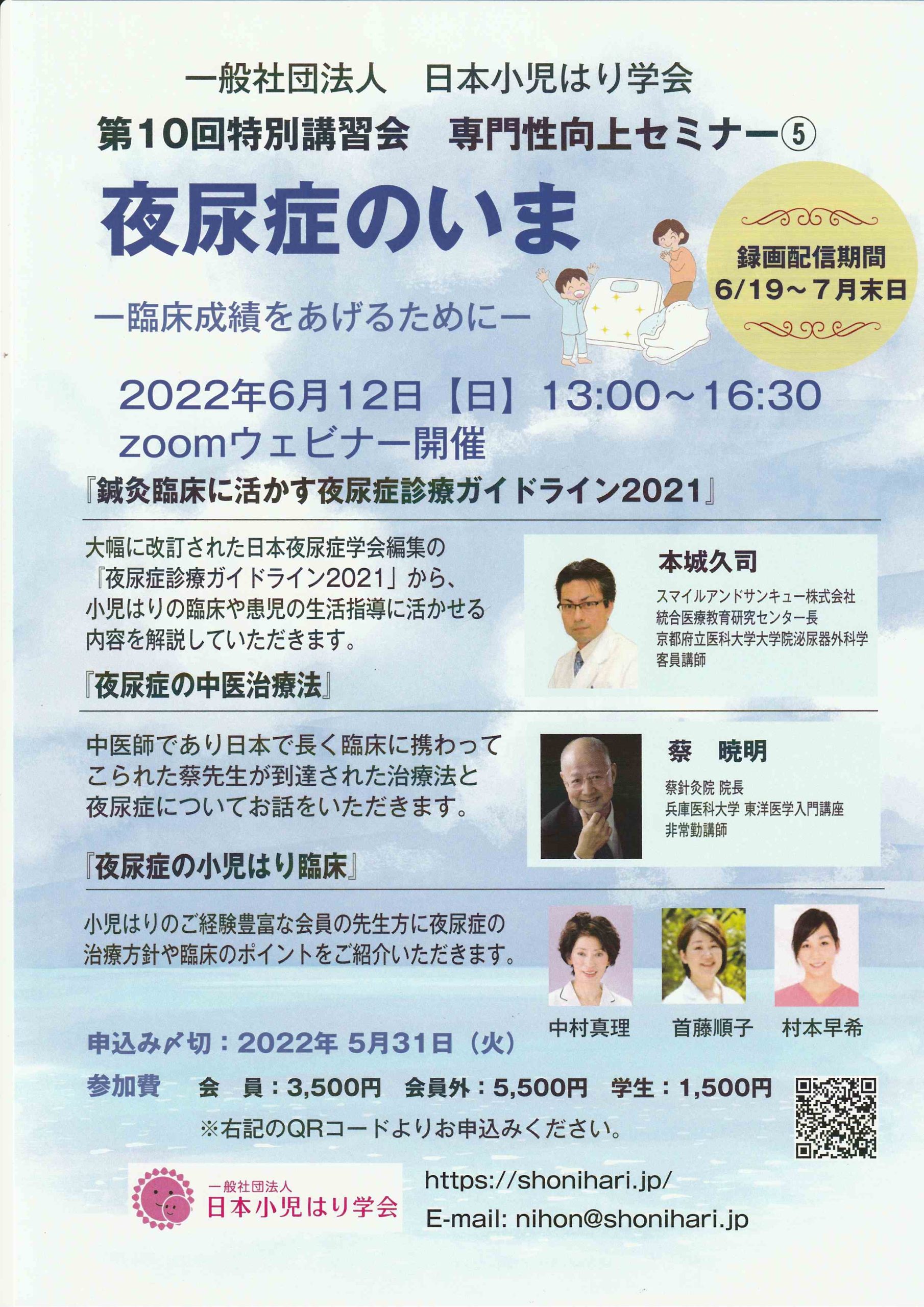
10th Special Training Seminar
“Bedwetting Today – Improving Clinical Outcomes –”
9th Special Training Seminar
“Differential Diagnosis of Common Pediatric Diseases – To Avoid Missing Warning Signs (Red Flags) –”
8th Special Training Seminar
“Night Crying and Shonihari (Pediatric Acupuncture) – From the Practice of 83 Cases –”
7th Special Training Seminar
“Understanding Developmental Disorders and Shonihari (Pediatric Acupuncture) Approaches”
6th Special Training Seminar
“Treatment of Atopic Dermatitis”
5th Special Training Seminar
“Shonihari (Pediatric Acupuncture) for Dementia”
4th Special Training Seminar
“Presenting Shonihari (Pediatric Acupuncture) Case Reports and Case Studies at Academic Conferences and in Journals”
3rd Special Training Seminar
“Shonihari (Pediatric Acupuncture) Treatment for Children with Developmental Disorders”
2nd Special Training Seminar
“Practice and Fundamentals of Shonihari (Pediatric Acupuncture)”
1st Special Training Seminar
“Theory and Practice of Shonihari (Pediatric Acupuncture)”
Certified Pediatric Acupuncturist
What is a Certified pediatric acupuncturist?
One of the objectives of the academic society is developing acupuncturists capable of the high skills for Shonihari so that more children would be able to receive the benefit of the highest standard treatment equally by Shonihari which promotes healthy development.
A member who has high standard skills of pediatric acupuncture with satisfying certain conditions, thus who is constantly studying and striving to promote, we qualify as Certified pediatric acupuncturist.
List of Certified Pediatric Acupuncturists
(as of September 2025) Link
The Japanese society of pediatrics acupuncture offers membership as follows.
Regular member
Companies or individuals who agree with our objectives and have joined the membership.
Admission fee/Annual fee
Admission fee 3,000 yen
Annual membership fee 7,000 yen / per year
Although The Japanese society of pediatric acupuncture, paid reasonable attention to the quality, function, etc. of the Contents, we make no representations or warranties in connection with the Contents, those with respect to the accuracy, safety, and reliability.
We shall not be responsible or liable for any loss, damages (whether actual, consequential, or otherwise), injury, claim, liability, or cause of any other kind or character arising out of, or resulting from any use of or access to this website.
We reserve the right to correct any errors or omissions in any portion of the site or to change, modify, remove, terminate or suspend any portion hereof, at any time without notice.
In addition, those contents changed, suspended, or canceled for which we shall not be responsible or liable to any person or entity whatsoever, (for whatever reason) for any loss, damages, injury, claim, liability.
This site including all contents, unless clearly stipulated otherwise, herein contained is protected by copyrights owned or controlled by The Japanese Society of pediatrics acupuncture.
Except for “private use” items and “quotes” covered under the Copyright, persons wishing to make use of materials appearing on this website are required to apply to do so with our society office.
If you wish to use the contents, please contact the secretariat of the Society in advance.
This website is not link-free.
If you wish to link to this website, please obtain prior approval from the secretariat of the society.
Please note that we may decline the link depending on the method and content of the link
Access
Secretariat of The Japanese Society of Pediatric Acupuncture
Address: 537-0025 1st Floor, 4-3-19, Nakamichi, Higashinari-ku, Osaka, Japan
E-mail: nihon(@)shonihari.jp
*Please remove the parentheses when sending